Building the Amati Gondola – Part 5

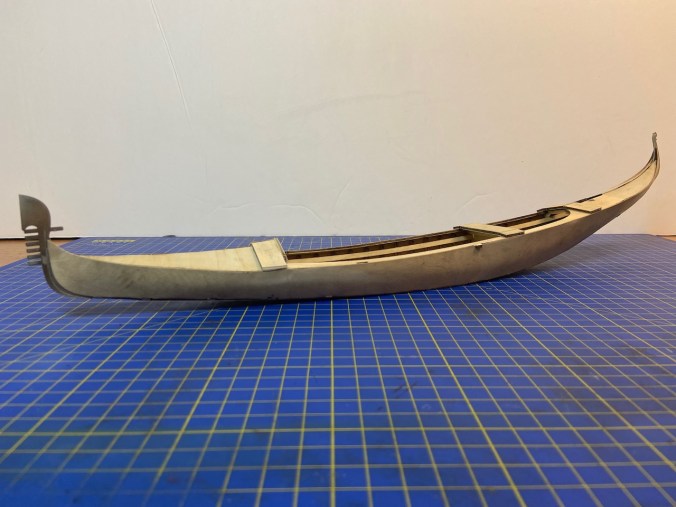
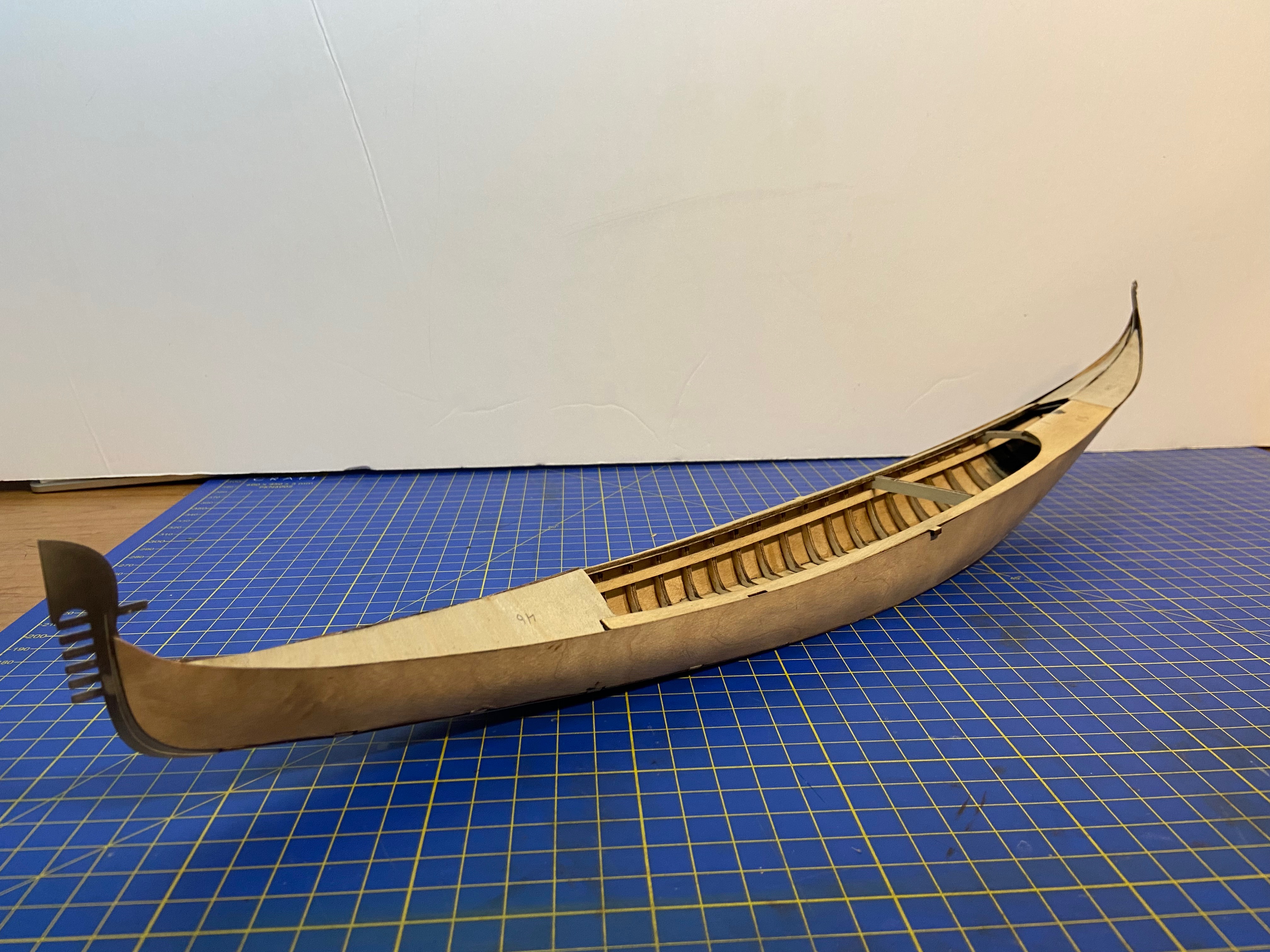
Progress on the Amati Venetian gondola kit continues with the addition of various hull details. The model has a lot of various panels that need to be added to the basic hull. As with nearly all the parts in this kit, these are laser-cut pieces, and in some cases, fitting them to my imperfectly built hull takes a little fiddling with.

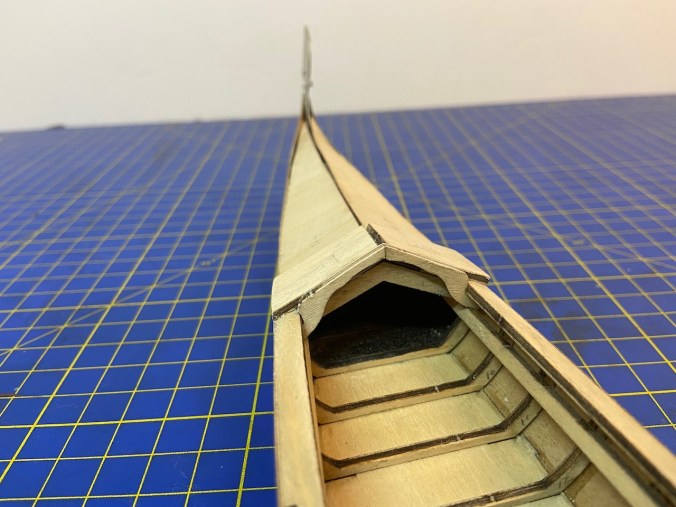
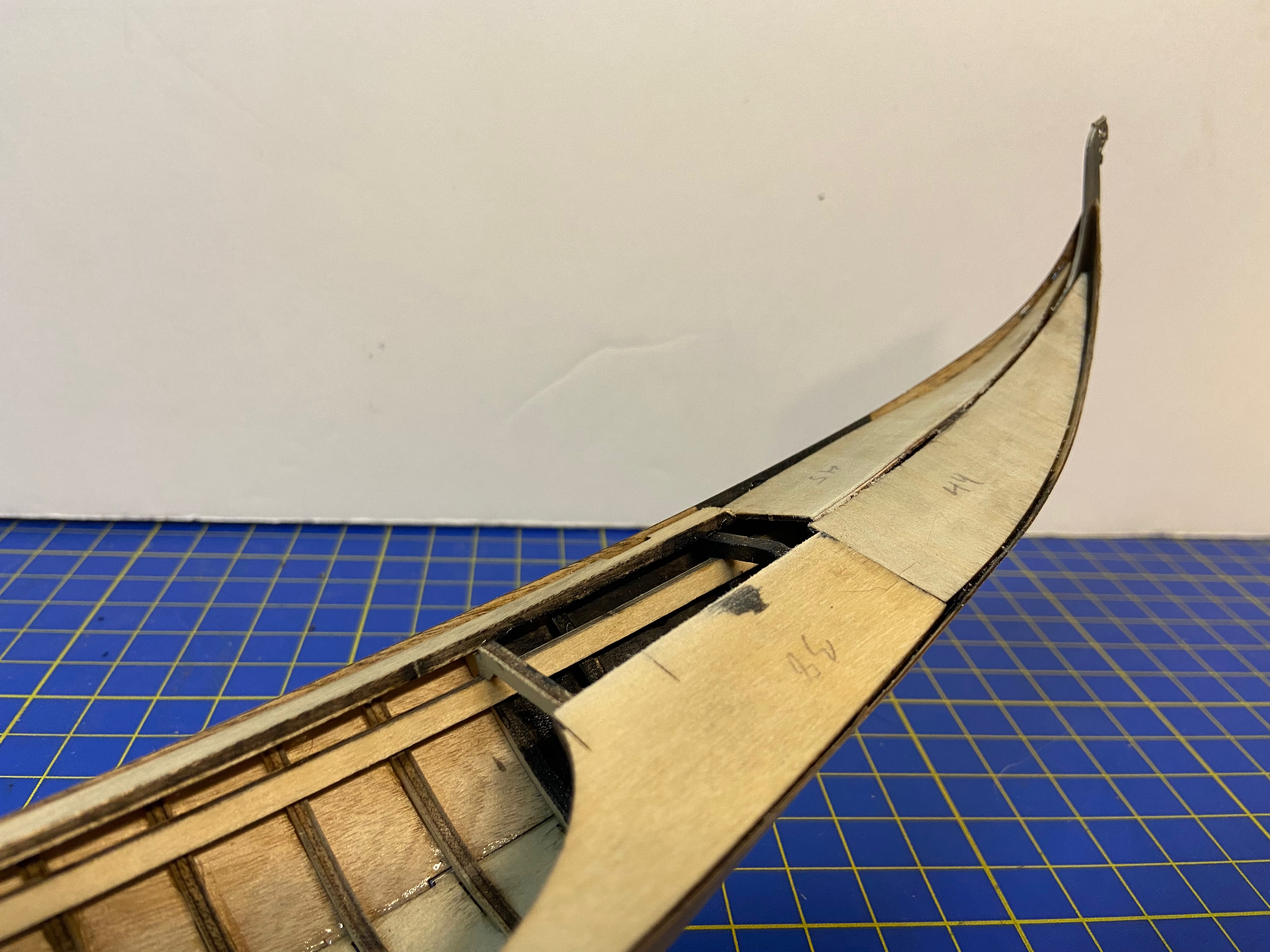
These decks at the ends of the hull are the last of the parts that make up the “basic hull”.

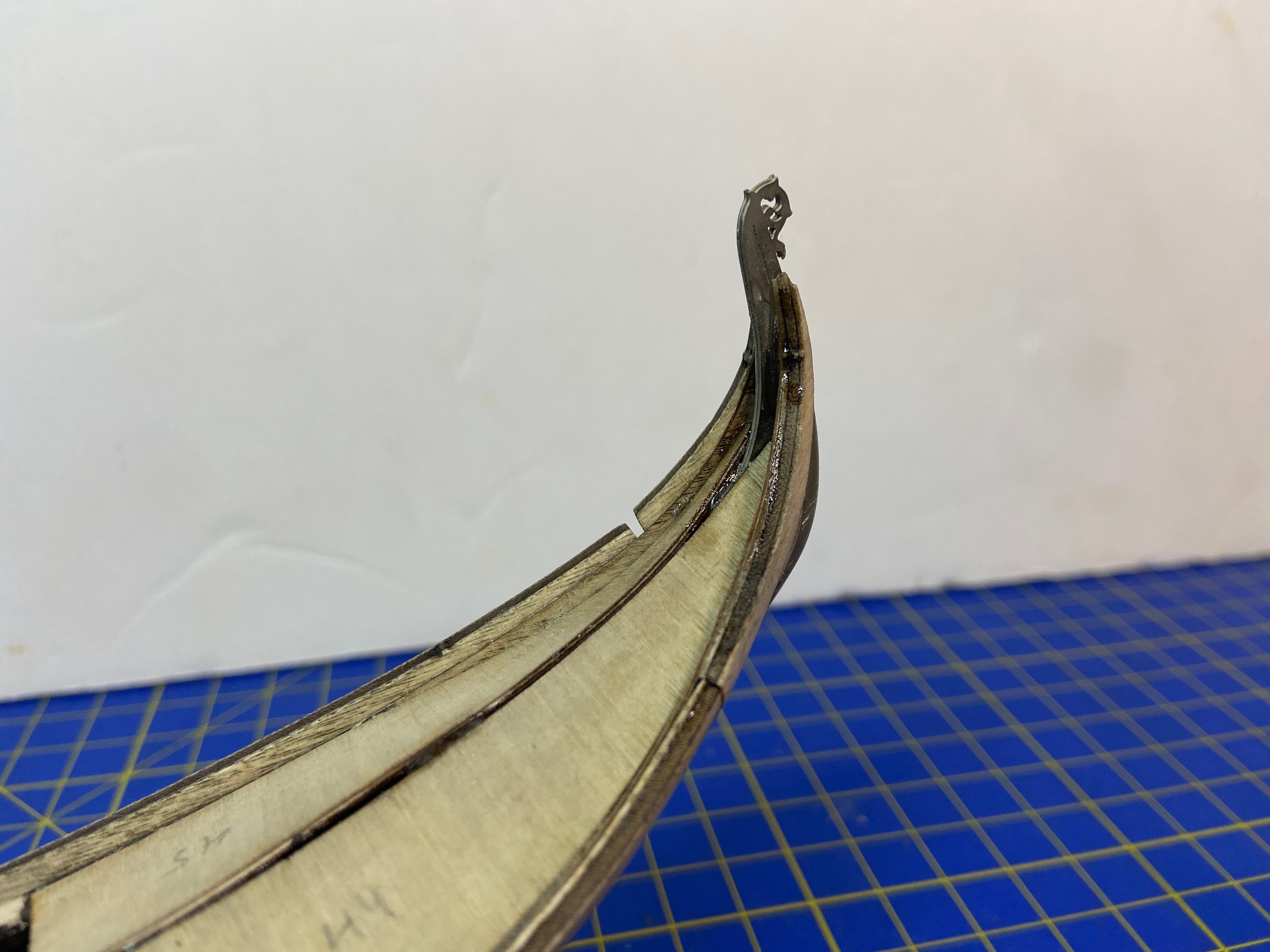
But, the part that I was most apprehensive about, was the addition of what might be considered a rub rail, which is a set of pieces that line the upper edge of the hull. Again, these are laser-cut plywood piece, and I was a bit concerned that they might not fit my hull very well, since I still feel that my initial placement of the hull pieces might be off, and the metal pieces at the ends don’t fit exactly as I think they should.

End pieces of the deck don’t line up exactly, but the edge will be hidden by other parts.

Still, things seem to look okay, and I seem to be able to adjust the parts so that they seem to fit. I just keep getting this feeling that I’ll eventually run into a problem because I didn’t mount things quite right, and it’s difficult to tell for sure from the instructions and drawings. This may just be my paranoia from having built other kits using all laser-cut parts.

At this point, I’m mostly dealing with the placement of detail parts, which go on pretty easily.

Next, we get to that rub rail I mentioned earlier. In the photos below, you can see that I didn’t get the starboard side piece correctly mounted, and you can see a gap at the stern. I wasn’t going to worry too much about this, figuring I could use filler to close the gap. But, then it dawned on me that there are some photo-etch pieces that will be added to this rail, so I can’t be changing the length. Instead, I’m removing the piece and adjusting it to fit better.

Since I’ve been using slow-curing CA glue, as recommended in the kit instructions, I had to use a little bit of CA de-bonder, which actually works quite well. Applied with a cotton swab, it was enough to soften the glue. Then, I could separate the piece from the hull using a knife blade. Afterwards, I made sure to clean up the area well, so a new glue joint would hold, but had not problem re-gluing.

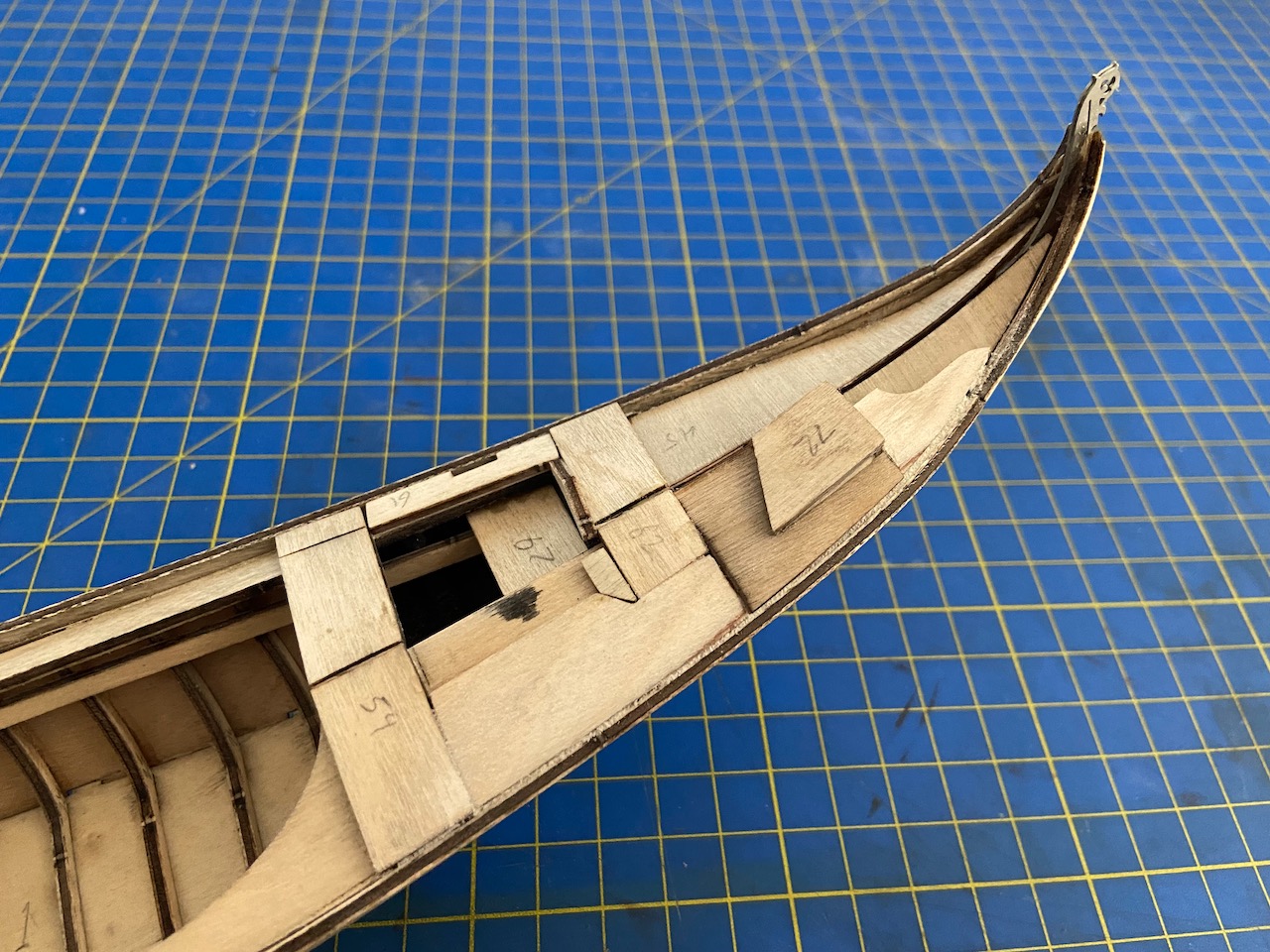
After that, I added all the various details at the stern of the gondola. I think this mostly has to do with providing a solid foothold for the gondolier, and providing him a place to maybe sit while he’s not working, but that’s just a guess. I wish the instructions were a little more explicit about what each of the parts are for. I think that would make it easier to build, because logic and knowledge of the use of the parts can aid in making sure the parts are correctly fitted. But, a bit of Internet research helps, as there are many photos of Venetian gondolas posted online.

All these parts look something of a mish-mash of pieces stuck to the aft deck. Once things are cleaned up, filled, primed, sanded, and painted black, it will hopefully start looking like the unique and beautiful canal boats it is supposed to represent.

The next step is to seal/prime the whole thing. There’s still many things to add before painting begins, but I’m getting kind of anxious to get the first layers of paint on the model. Won’t be long now…

From My Library: Historic Ship Models, by Wolfram zu Mondfeld

A useful overview of a classic ship modeling book.

catopower's avatarShip Modeler

I just thought I’d take a little timeout today to tout one my favorite ship modeling references, the book Historic Ship Models, by Wolfram zu Mondfeld. I mention this title in the Books page of my Resource menu, but I felt it important enough to dedicate a post to it.

This is a classic reference book for ship modelers that was originally published in German, but has been printed in English since at least 1989.

Historic Ship Models by Wolfram zu Mondfeld

The book is actually out of print, as far as I know, but new and used copies are pretty easy to find, and they’re not expensive. I’ve worn out my original copy from referring to it so much, but I had no problem getting a replacement copy in good condition for around $6.

View original post 496 more words

My Inherited Amati HMS Prince Kit

Ship modeler Clare Hess discusses his acquisition of a vintage kit of HMS Prince that Amati produced at one time. While Amati no longer makes the kit, it still sells the entire set of cast brass decorations as well as the plans. So, if you’re interested in building this kit yourself, you still can. You don’t even have to get the decorations as a full set. If you prefer, you can order them individually, as needed. At Ages of Sail, we’ve got it all, including wood strips, cannons, and all the other assorted fittings you’ll need to complete a model like this.

catopower's avatarShip Modeler

The Amati HMS Prince kit is my latest acquisition. It was started by a modeler by the name of Richard Fletcher, who passed away earlier this year. His wife, Pam, wanted it to go to a good home, because Richard had enjoyed working on this model so much. Obviously, he had done a lot of work on this model. I had purchased another one of his kits, an unstated Mantua/Sergal Sovereign of the Seas, so the Prince basically came along in the deal.

View original post 973 more words

Diorama Water Crafting, Online Workshop with Ron Neilson, June 17, 2023

This looks like a very interesting and useful workshop!

catopower's avatarShip Modeler

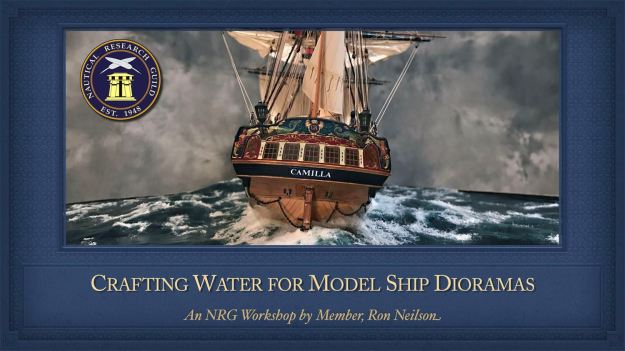
Saturday, June 17th is a very special day, and not only because it happens to be my birthday. Mark your calendars for an online workshop arranged by the Nautical Research Guild on Diorama Water Crafting, which will be presented by good friend and outstanding ship modeler Ron Neilson.

The workshop will take place via Zoom at 10:30am Central Time, and you will need to be a paying member of the NRG in order to attend, though the event itself is free. I myself plan on attending, though it requires I start off my birthday sitting in a Zoom session at 8:30am (It’s Pacific Time here).

Ron has done some really amazing diorama work, having migrated over from the usual static model displays, and will be showing us how to take an ordinary model (or perhaps an extraordinary one) and bring it to life by placing the subject in it’s natural…

View original post 115 more words

Building a Monterey Salmon Fishing Boat, c. 1916 – Part 3

Sometimes, a ship modeling subject just isn’t available in kit form. Take a look at this 1916 era Monterey salmon fishing boat being built from scratch.

catopower's avatarShip Modeler

I’m happily keeping focussed on the Monterey salmon boat and making good progress. Most recently, I had primered the hull, coamings, and deck house. I felt I was far enough along to go ahead and do some full on painting. I masked off the hull and painted the whole hull with Tamiya gloss white spray lacquer.

View original post 906 more words

Building the Amati Gondola – Part 4

Gluing the hull sides to the frames was a bit of a challenge, as the bottom has to curve up at the ends, and the hull sides have to curve inward, so that the ends meet. It would have been nice if this kit had been designed with some sort of building jig, rather than relying on tape to hold things into place while the glue dries.

However, I did find that taping, plus the heavy use of small spring clamps did the trick. Be sure you have plenty of these on hand before you start gluing the hull sides onto the frames. This step is so important that I thought I’d post this image again of the gluing process, showing all the tape and clamps I needed to use.

Continue reading

New Franklin Expedition Ship – HMS Erebus from OcCre

First, there was HMS Terror, one of two ships of the Franklin expedition, that disappeared in the Arctic during a search in 1845 for the Northwest Passage. OcCre introduced that kit back in 2018. OcCre’s newest release is the other ship of that ill-fated expedition, HMS Erebus.

Of the two ships, Erebus was the lead ship, under the command of Sir John Franklin himself, but the two ships were very similar. Both ships were converted bomb vessels, received the same modifications for Arctic service, including the addition of steam propulsion, and both had similar deck layouts. Now, you can build a 1/75-scale reproduction of this most famous ship, or model the Franklin Expedition with OcCre’s 1/75-scale HMS Terror kit.

The kit includes laser-cut wooden parts for the hull framing and many structural details. Wooden strips for a double plank-on-bulkhead construction, wooden dowels for masts and spars, planking material for rather unusual deck planking arrangement, step-by-step illustrated instructions, fittings in wood, cast metal and brass, and a full set of pre-sewn sails.

Check out the new kit, now in stock, here: https://www.agesofsail.com/product/hms-erebus-occre-1-75/


Building the Amati Gondola – Part 3

I added the remainder of the frames to the model, which didn’t take all that long to do. Overall, this early part of construction is pretty easy. However, the next step, the adding of the hull planks, looks to be the hardest part of the whole build.

The next step involves preparing the hull plank pieces, of which there are only two. These pieces need to be shaped to fit the curved frames. The easiest way to do this is with an electric plank bender, as described in the kit instructions.

Continue reading

Building the Amati Gondola – Part 2

Construction of the Gondola model has begun. As expected, this is looking like it will be a pretty quick build. But, it’s definitely something that requires attention to detail and careful reading of the instructions. Builders who rush forward, may be prone to some simple, but critical mistakes. This is probably why Amati does not considered this to be a beginner’s kit.

By the way, anyone who is interested in following this build log with their own build, you can buy this kit for $129.00 plus tax and shipping at Ages of Sail here. As you are building, follow along and email any questions or note any problems you have about the build to us at blogger@agesofsail.com. We’ll make sure you get personal attention on this project. Send us photos and we’ll post them as we go as well.

Last time, we mentioned that what makes the Venetian gondolas particularly unique is the asymmetrical hull shape. You can see from the photo of the hull bottom that there is a noticeable curve in the hull.

The kit calls on the builder to begin by cutting out the main hull pieces and to identify (and become familiar with) which is the bow end. That’s the end that’s at the bottom of the above photo. It also suggest using fine sandpaper to clean up the surface of the parts from the char that comes from the laser-cutting process.

Continue reading

Building the Amati Gondola – Part 1

Gondola, the Jewel of Venice is the newest Amati wooden model kit, realeased earlier this year. It is a 1:22-scale wooden model kit that measures about 19-1/2″ long when complete.

This is not the first time that Amati has produced a gondola kit. Amati had produced a different kit of a Venetian gondola. That one was a 1:20 scale model, very similar is size to this one. I don’t have much information about the old kit other than the scale and that it was a model of a gondola of 1882, which had a little cabin for the passengers.

This new kit has the appearance of the modern gondola as it appears on the canals of Venice today. So, let’s take a look at what’s included in the box. Continue reading